
Did you know...
that West Virginia has a State Gem?
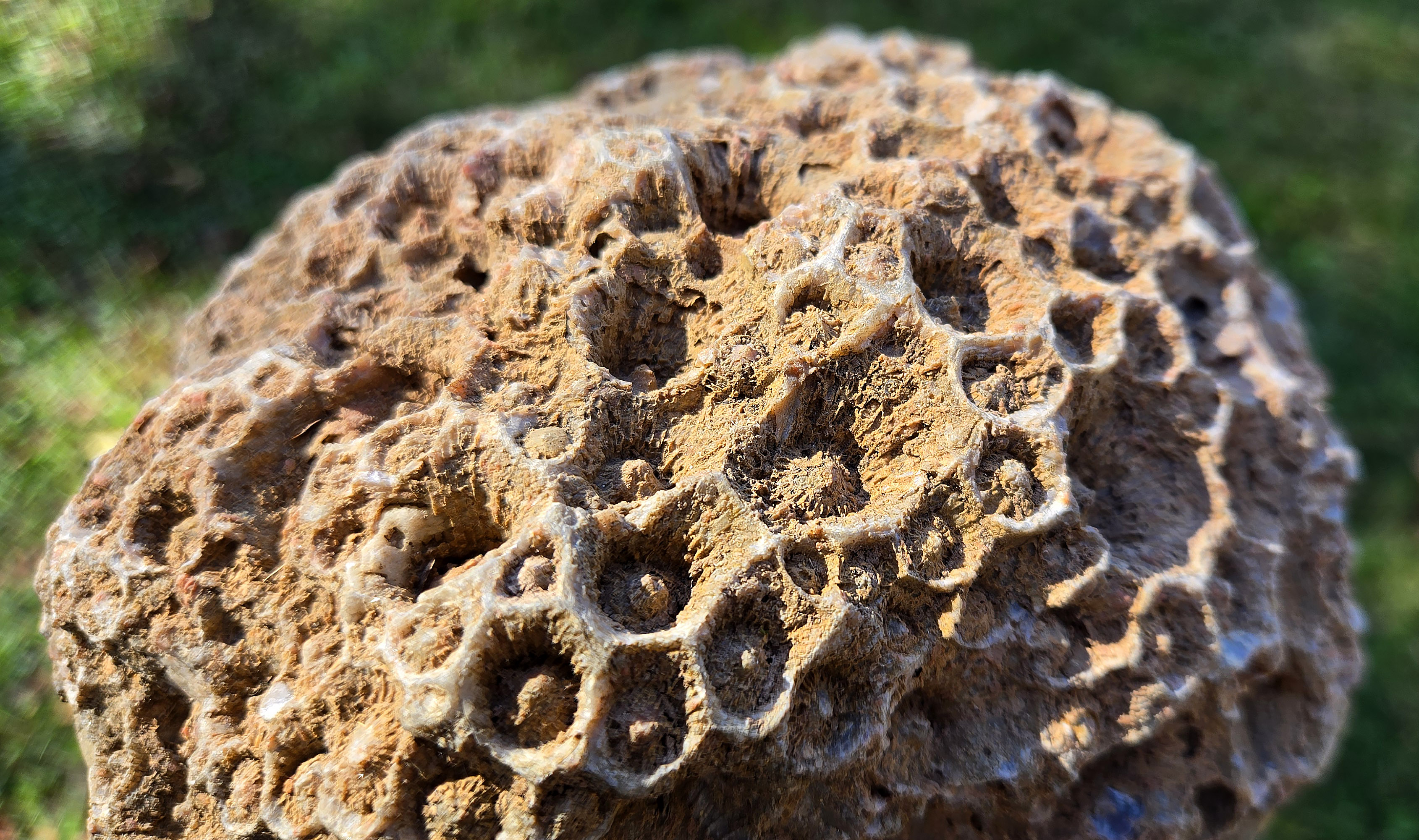
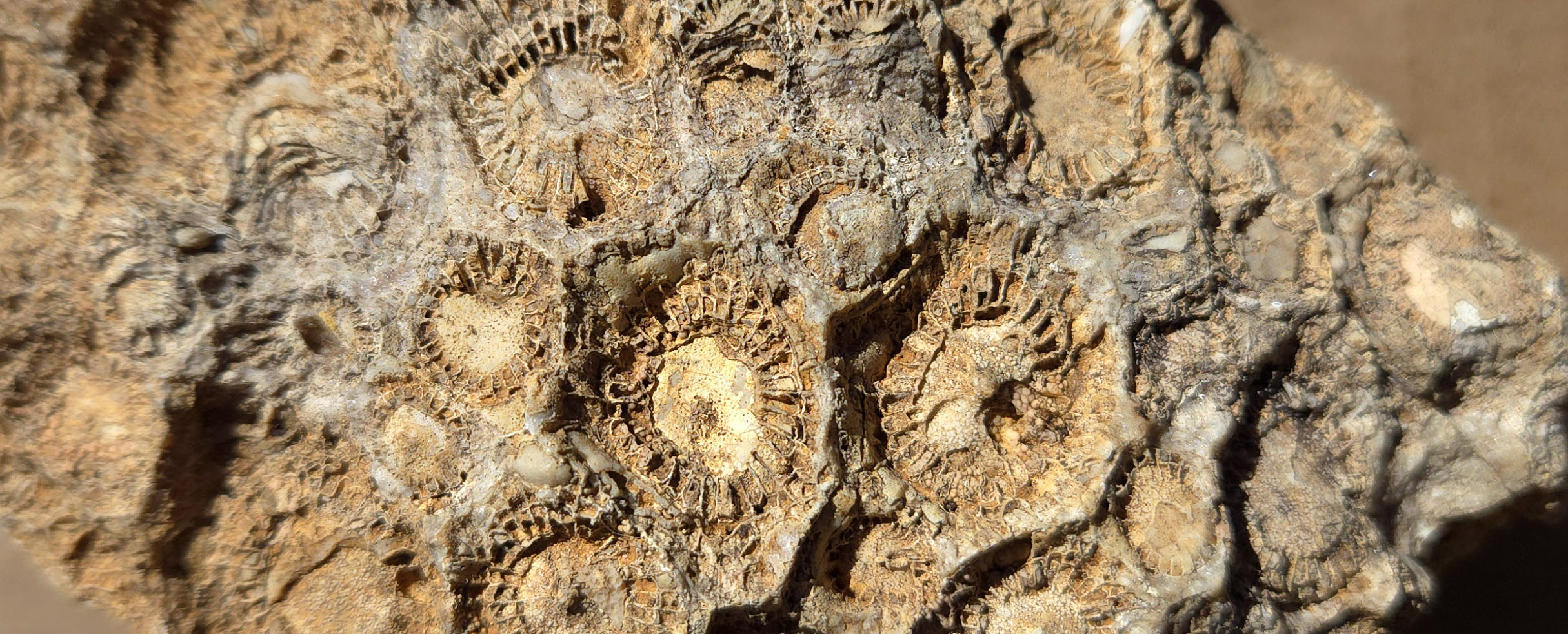
Lithostrotionella is a colonial rugose coral that once lived in West Virginia. The fossilized remains are found within the Hillsdale limestone formation, in Greenbrier and Pocahontas counties. It lived during the Mississippian Period, when West Virginia was much different. From roughly 359 to 323 million years ago, the region was a warm, shallow sea harboring ocean life. Lithostrotionella, like other marine organisms, became preserved in time when forces of nature transformed this area from an ocean habitat to the swamps which gave us today's coal.
At a first glance, people may not realize that West Virginia used to be covered in ocean. However, there are signs. It is not unusual to find fossilized marine life in such mundane things as limestone for a driveway. Limestone is actually a deposit from this ancient ocean. Places like streams where stone is being eroded may in the right places show signs of marine life. Streams can also be good "catches" for loose specimens to simply accumulate over time. A random stop at a road cut might yield a fossil from this ancient ocean. If someone knows what they are looking for, the signs are actually all around us.
In North America, the Carboniferous period is divided into the Mississippian and Pennsylvanian subperiods based on regional stratigraphy. During the Mississippian subperiod, North America was positioned near the equator and was covered by shallow seas. This was the ideal environment for many forms of marine life but especially an Echinoderm called the Crinoid. A nickname for the Mississippian is "The Age of Crinoids," due to their abundance. Their skeletal remains were a large contributor to the limestone deposits from that time. Other forms of ocean life found fossilized from that time are Brachiopods, Bryozoans, and Corals like Lithostrotionella. When the Mississippian subperiod was ending, the land masses of Euramerica and Gondwana were colliding and beginning to form the Appalachian mountains. Sea levels were also dropping due to glaciation on Gondwana. Natural forces were slowly altering the continents and removing the ideal environment for much marine life. The seas would change to deltas, and then swamps, and eventually to the land as we find West Virginia today.
What remains from that time have become deposits which contain fossilized remnants of organisms. Layers such as the Hillsdale Limestone deposit are examples of these remains. In places where the layer has been exposed it is possible to collect marine fossils. "Lithostrotionella" is a coral which has been agatized in places within this layer. Another term for this process is silicification or petrification. Coral excretes a calcium carbonate exoskeleton to protect itself, creating a structure called a corallite. The coral polyp can retreat into a calyx at the top when threatened, and extend its feeding arms when it is safe. These corallites are what have been left behind and eventually fossilized. In the right locations coral heads have eroded from the softer limestone and can be collected with little effort.
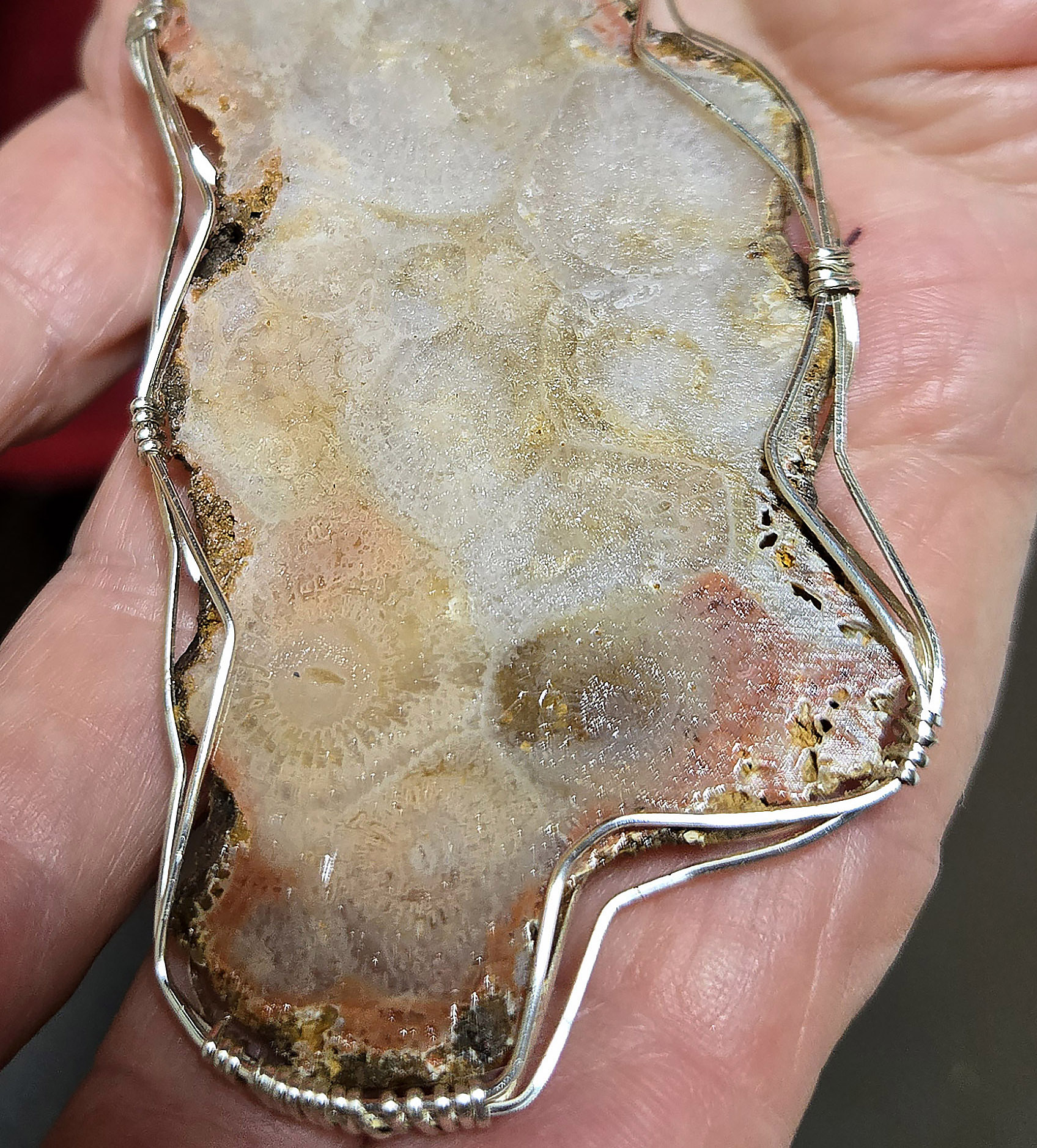
Lithostrotionella can be sliced with the right equipment and polished. This piece has been wire-wrapped and made into a necklace.
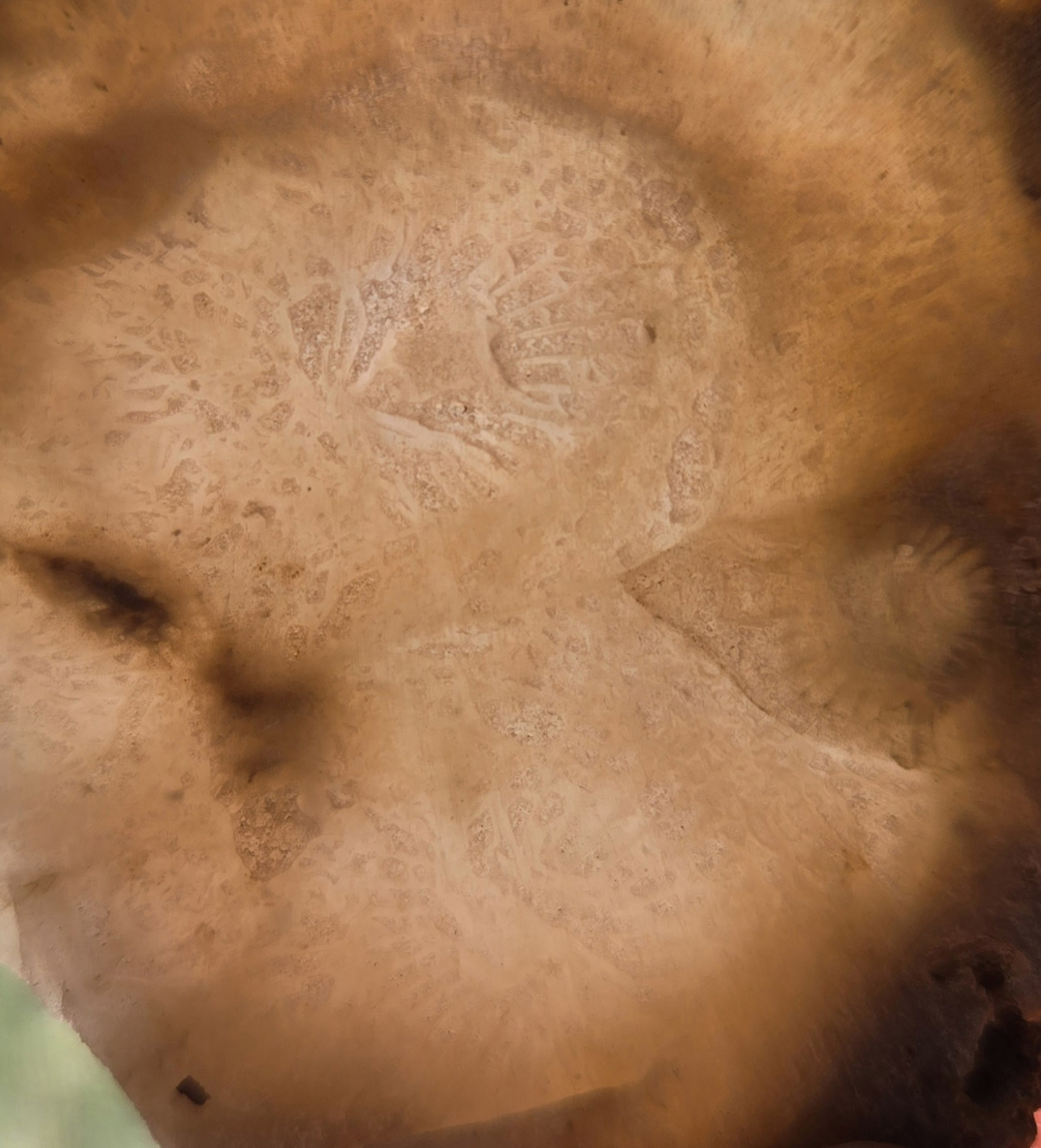
By holding this thin slice to a light source, the internal structure can be seen.
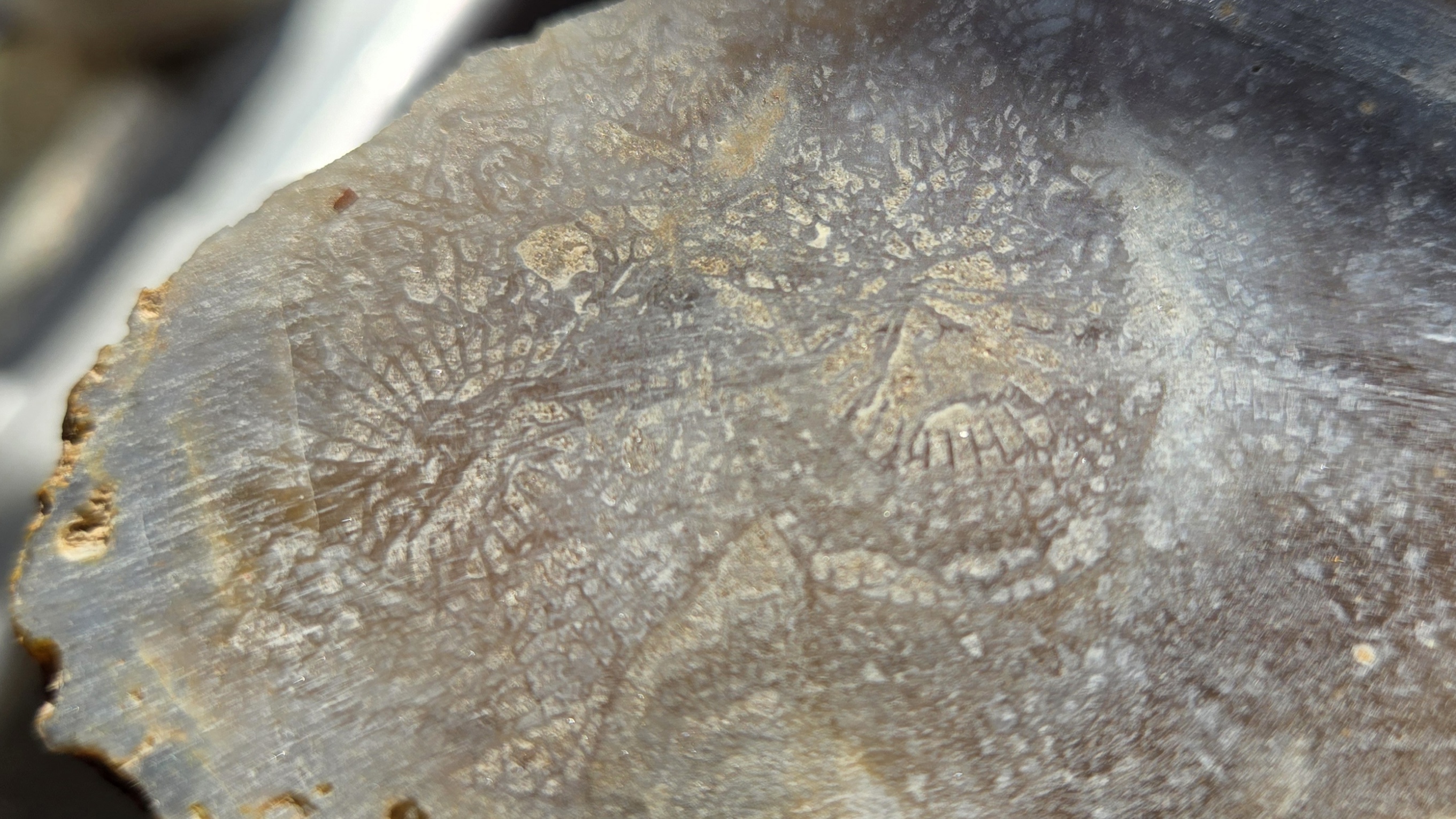
Sometimes coral heads become dislodged in streams and tumble. Eventually they can also shear, showing the internal structure of the head.
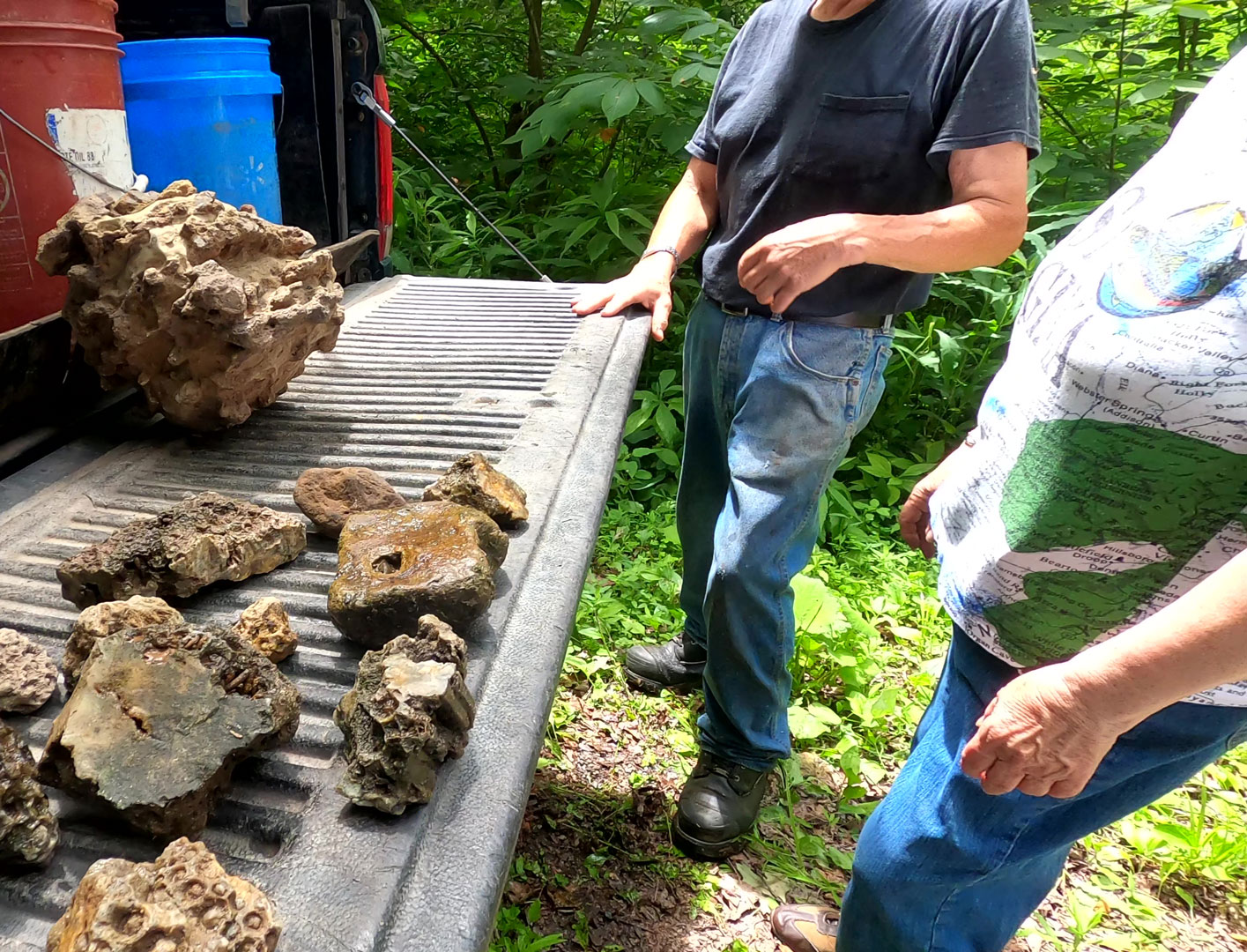
Joe Hall and Sue Hurst observe a collection of agatized coral.
Supporters of establishing the state gem reportedly spent 10 years at work, with measures stalling in the Senate. James Guthrie, a member of the Kanawha Rock & Gem club, was a vocal proponent. “In some places there's so much of it, farmers throw it down sinkholes to get it out of the way,...some pieces, called 'coral heads,' weigh as much as 15 pounds." (Charleston Gazette-Mail, June 15th, 2013 reprint). It was speculated that establishing the state gem could be an economic driver for Greenbrier and Pocahontas Counties. By this time, 44 of the 50 states had an official gem. Finally, House Concurrent Resolution No. 39, March 10, 1990, designated the preserved coral as the State Gem.
Collectors have found that the agatized coral has unique qualities of it's own. When cut and polished, the inner structure of the corallites can be seen and the luster of the gemstone becomes apparent. It is not unusual to find polished coral for sale at some local gem and mineral shows. The stone tends to have a red or blue tone, due to mineral impurities imparting color.
Below is a gallery of Lithostrotionella specimens. Enjoy!
Sources:
The University of IowaAccessed October 2th, 2025
State of West Virginia, 1990, Journal of the House of Delegates, sixty-ninth Legislature of West Virginia, Vol. 1 pp 791-792
https://ohiodnr.gov/discover-and-learn/rock-minerals-fossils/fossils/colonial
Ohio Department of Resources
Accessed October 2th, 2025
“Corallite,” Merriam-Webster.com Dictionary, Merriam-Webster
Accessed 2 October 2025
West Virginia Geological and Economic Survey FAQ,
Accessed 2 October 2025
U.S. G.P.O. (1983). Revision of Lithostrotionella (Coelenterata, Rugosa) from the Carboniferous and Permian (Professional Paper No. 1247). U.S. Geological Survey.
Accessed 3 October 2025
"Geologic Time Periods in the Paleozoid Era: Mississippian Period—358.9 to 323.2 MYA"
Accessed 27 November 2025
"State Gem: Fossil Coral Comes from Land's Oceanic Past," Rick Steelhammer, June 15th 2013
Accessed 27 November 2025
Hillsdale Limestone
Accessed 27 November 2026